
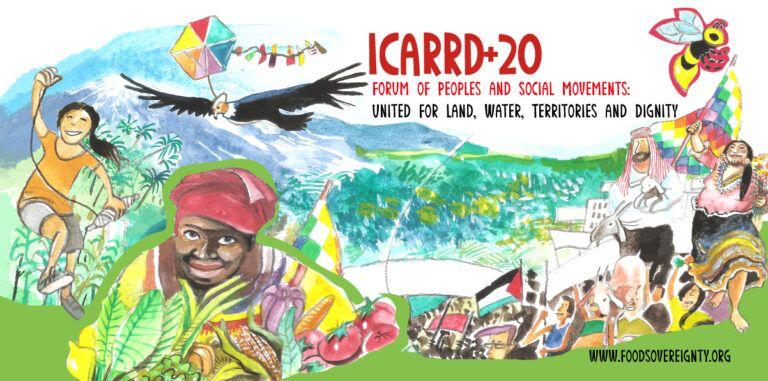
As governments, social movements, and multilateral institutions gather in Cartagena for ICARRD+20 to advance agrarian reform and rural development, the Stop Financing Factory Farming (S3F) Campaign is calling for an urgent shift in global development finance.
Public and multilateral development banks must end financing for industrial livestock and redirect resources toward agroecology and equitable food systems.
Twenty years after the first ICARRD, land inequality, rural dispossession, and ecological decline remain urgent global challenges. Development finance continues to shape land use, agricultural systems, and rural livelihoods and too often, it is reinforcing the very crises agrarian reform seeks to resolve.
Development finance is far from neutral, noted Mariann Bassey-Olsson, S3F Africa Regional Coordinator. “Public and multilateral development bank financing of industrial livestock is driving deforestation, land conversion for feed production, and land concentration,” she emphasized.
“These investments directly undermine climate goals, biodiversity protection, and the vision of sustainable rural development.”
Industrial livestock production relies heavily on monoculture feed production, accelerates forest destruction, increases greenhouse gas emissions, and subjects billions of animals to intensive confinement and chronic suffering, while entrenching export-oriented agribusiness models. Rather than supporting equitable land distribution and community resilience, such financing consolidates corporate control over land and food systems.
Multilateral development banks claim that their financing of industrial livestock production boosts food security. However, industrial production is dependent on feeding grains such as wheat and corn to animals who convert these crops very inefficiently into meat and milk. This undermines food security.
A new report shows that if the grain fed to livestock were instead used for direct human consumption, worldwide an extra 2 billion people could be fed each year.
Across Africa and Latin America, including Colombia, the host of ICARRD+20, communities continue to resist land grabbing, ecological destruction, and rural decline linked to industrial agriculture expansion.
Industrial livestock systems are also reshaping rural economies in ways that deepen inequality, warned Opeyemi Elujulo, S3F Youth, Policy & Campaigns Lead. “Factory farming concentrates ownership and decision-making power in the hands of large agribusiness corporations, displacing small-scale producers and Indigenous landowners,” he stated. “Women, youth, and marginalized communities bear the heaviest burden. This is not rural development, it is rural dispossession.”
In many regions, industrial livestock expansion is promoted as modernization or food security. However, grassroots movements and smallholder farmers consistently highlight its damaging social and environmental consequences. The expansion of these systems undermines local food sovereignty, increases dependency on global commodity chains, and weakens community resilience.
ICARRD+20 presents a critical opportunity to realign development finance with its stated goals of reducing rural poverty, supporting agrarian reform, and advancing sustainable development.
Redirecting financial flows can transform land outcomes and rural futures, stressed Claudia Escorza, S3F Latin America Regional Coordinator. “Shifting public finance away from factory farming toward agroecological and diversified food systems supports more equitable land use, strengthens resilient rural livelihoods, and aligns with climate and biodiversity commitments,” she affirmed. “Public money must serve the public good, not corporate concentration.”
Agroecology and diversified food systems offer proven pathways that support small-scale farmers, protect land rights, and strengthen local markets. Across regions, agroecological approaches have demonstrated increased climate resilience, improved soil health and fertility, enhanced biodiversity, reduced input costs, and greater income stability for farming communities. Evidence from multiple regions shows that agroecological systems can maintain – and often improve – yields while reducing dependency on costly external inputs, thereby boosting farmers’ incomes and livelihoods.
These systems promote gender equity, strengthen community food sovereignty, and contribute to long-term rural sustainability. Redirecting development finance toward these approaches is essential to achieving meaningful agrarian reform that is both socially just and economically viable.
The Stop Financing Factory Farming Campaign is calling on governments and multilateral development banks participating in ICARRD+20 to:
● End public and multilateral financing for industrial livestock and factory farming projects;
● Conduct transparent reviews of existing agricultural investment portfolios;
● Redirect financing toward agroecology and community-led, small-scale food systems;
● Align agricultural investments with climate, biodiversity, and human rights commitments;
● Guarantee meaningful participation of grassroots movements, women, youth, small-scale farmers and producers, and Indigenous Peoples in agricultural financing decisions.
Agrarian reform cannot succeed without transforming how development finance is structured and deployed. Development banks cannot credibly champion rural equity while funding systems that accelerate land concentration, environmental degradation, and social inequality.
ICARRD+20 must mark a turning point.
The future of rural development depends not only on policy commitments but on where public money flows. It is time to stop financing factory farming and start financing food systems that nourish communities, protect ecosystems, and uphold justice.
About the Stop Financing Factory Farming (S3F) Campaign
The Stop Financing Factory Farming (S3F) Campaign is a global coalition advocating for an end to public and multilateral development bank financing of industrial livestock. S3F works across Africa, Latin America, Europe, and globally to redirect public finance toward agroecology, food sovereignty, and just, climate-resilient food systems.