
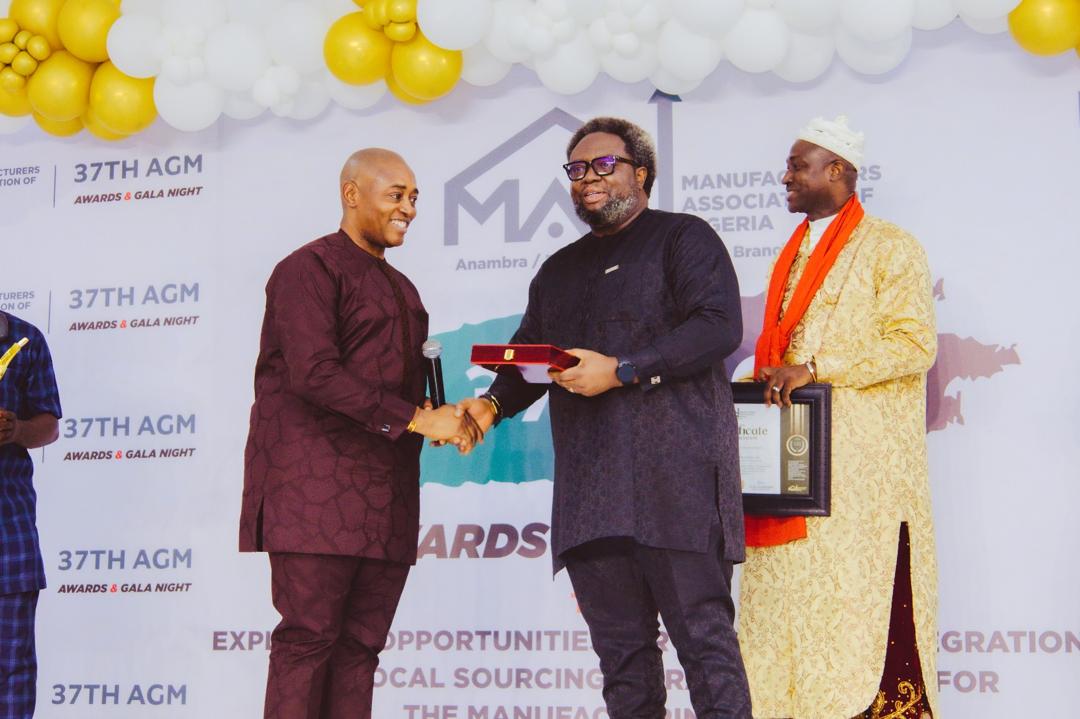
The Deputy Governor of Enugu State, Barr. Ifeanyi Ossai, presenting an award of excellence to Prof. Ike-Muonso at the 37th MAN AGM
The Director General/CEO of Raw Materials Research and Development Council (RMRDC), Prof. Nnanyelugo Ike-Muonso, has renewed calls for Nigeria to embrace backward integration and local sourcing of raw materials, saying “it is the only viable pathway for industrial survival and sustainable national growth”.
Speaking at the 37th Annual General Meeting (AGM) of the Manufacturers Association of Nigeria (MAN), Anambra, Ebonyi, and Enugu States branch held at the International Conference Centre, Enugu, with the theme, “Exploring Opportunities for Backward Integration and Local Sourcing of Raw Materials for the Manufacturing Sector”, Prof. Nnanyelugo Ike-Muonso, said Nigeria can no longer afford to export its natural wealth in raw form while depending on imported finished goods at exorbitant costs.
According to him, this paradox has moved beyond being an economic inefficiency to becoming an existential threat to national stability and industrial development.
“Nigeria cannot survive exporting its raw materials only to import finished goods at high costs,” Ike-Muonso declared.
“In the first half of 2025 alone, Nigeria spent a staggering N3.53 trillion importing raw materials. That is N3.53 trillion not circulating in our economy, not creating jobs, and not building resilience in our supply chains.”
The DG emphasized that backward integration and local sourcing are not optional, but essential for the survival, stability, and sustainable growth of Nigeria’s manufacturing sector.
He described them as the roadmap to national industrial independence. He noted that over the years, the country’s import-dependent manufacturing model had collapsed, leading to severe foreign exchange pressure and capital flight.
“Within the first half of this year alone, Nigeria lost N2.6 trillion in costs and saw foreign investments shrink to a mere $129.9 million because we continue to build our industrial growth on foreign supply chains,” he said.
Prof. Ike-Muonso announced that the RMRDC 30% Value Addition Bill, currently awaiting Presidential Assent, would transform Nigeria’s industrial landscape. The bill mandates at least 30% local value addition to raw materials before export, ensuring that the nation’s natural resources are processed and manufactured locally.
He said the bill, when passed, would inject $7.5 billion into the GDP, create over 250,000 new jobs by 2030, and save $3.7 billion in annual import costs, positioning Nigeria as a regional value-chain leader.
“This legislation is not a restriction but a protection,” he explained. “It guarantees that the raw materials manufacturers need, such as lead, zinc, cocoa, and sesame, remain available for local use instead of being shipped abroad.”
Highlighting the untapped opportunities across the South-East, Prof. Ike-Muonso said that RMRDC has mapped out raw material corridors across Nigeria to enable industries access local inputs within short distances.
He pointed out that Ebonyi State sits on a wealth of minerals such as lead, zinc, limestone, kaolin, and feldspar; Anambra State is endowed with cassava and maize for starch and glucose production; while Enugu State has vast reserves of clay and oil palm that can drive the ceramics and vegetable oil industries.
“These are not theoretical potentials; they are tangible assets waiting for the marriage of policy and capital,” he said. “We must act decisively and quickly if we are to safeguard our industrial future.”
He urged state governments to champion the creation of raw-material corridors, develop infrastructure, power, and logistics systems, and establish shared processing facilities. “RMRDC will not be a spectator,” he assured. “We are ready to be your technical partner, providing data, investment, and advisory support.”
The Governor of Enugu State, Dr. Peter Mbah, represented by his Deputy, Barr. Ifeanyi Ossai, commended RMRDC for its leadership in driving industrial policy reforms through the proposed 30% Value Addition Bill.
The Governor described the bill as transformational and one that would reposition Nigeria’s economy on a path of value creation and sustainable growth.
“The RMRDC’s 30% Value Addition Bill is a game-changer that will transform Nigeria’s economy from dependency to productivity,” Ossai said. “I urge financial institutions, especially development banks such as NEXIM Bank, to prepare adequately to support this reform. Access to credit facilities at single-digit interest rates remains a major challenge and must be addressed to make the bill’s implementation successful.”
He further applauded Prof. Ike-Muonso for his insightful keynote presentation and the Council’s consistent efforts in promoting industrial growth through research, innovation, and strategic collaboration.
The Chairman, MAN Enugu, Ebonyi, and Anambra states branch, Dr. Adaora Chukwudozie, described backward integration and local sourcing as the surest path to lowering production costs, stabilizing supply chains, and expanding industrial capacity.
“With over 65% of production costs tied to imported inputs, this model is no longer sustainable,” she stated. “The RMRDC’s commitment to local sourcing is exactly what Nigeria needs to strengthen MSMEs, create jobs, and boost competitiveness.”
The 37th MAN AGM also witnessed the presentation of awards to Prof. Ike-Muonso alongside prominent business leaders, including the Cubana Group and BLord Group, in recognition of their contributions to industrial and economic development.